Product Manager
Performance+ for Guided Work
An analytics platform that transforms tagged workflow events into dashboards and actionable operational insights.
Product StrategyAnalyticsWorkflow Intelligence
Overview
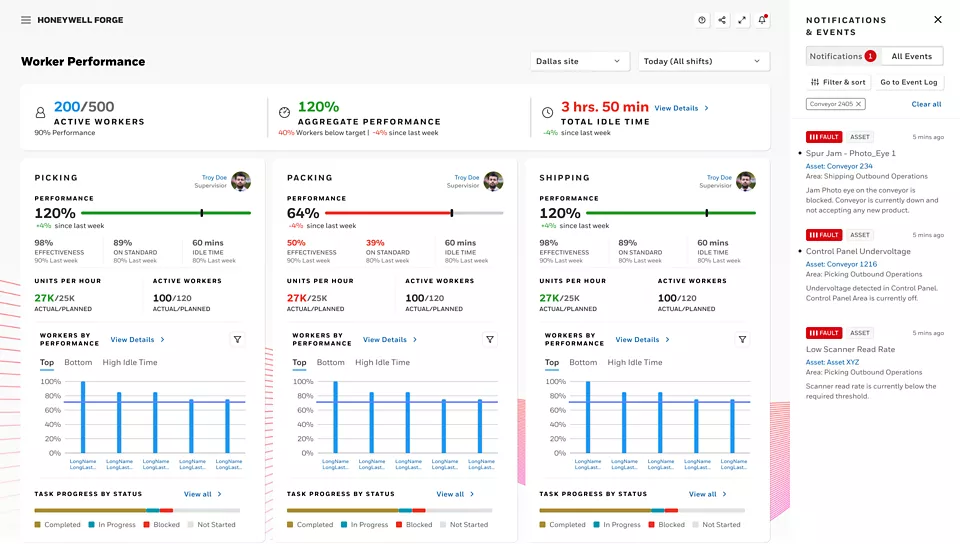
Performance+ is an analytics layer built on top of a guided-work execution platform. It captures tagged events from worker workflows — steps completed, time on task, exceptions triggered — and surfaces them through configurable dashboards for supervisors and operations leaders.
The Challenge
Operations teams were flying blind. Guided-work workflows generated rich behavioral data, but none of it was accessible in a structured way. Supervisors had no visibility into where workers were struggling, and leadership couldn't tie execution patterns to business outcomes.
My Role
As Product Manager, I owned the end-to-end product lifecycle — from initial discovery through delivery. I led cross-functional alignment between engineering, design, data science, and customer success to ensure the platform met real operational needs.
Approach
I started with deep customer discovery, interviewing supervisors and operations managers to understand their decision-making processes. From there, I mapped the data pipeline — identifying which workflow events were most valuable, how they should be tagged, and what views would be most actionable. I worked closely with design to create a dashboard experience that balanced depth with simplicity.
What I Delivered
- Configurable dashboards showing worker performance metrics, task completion rates, and exception patterns
- A tagging framework that let implementation teams map custom workflow events to analytics dimensions
- Role-based views for supervisors (team-level) and operations managers (site-level)
- Automated alerting for performance thresholds and trend deviations
Outcome
The platform gave operations teams their first real-time visibility into guided-work execution. Early adopters reported a measurable reduction in time spent on manual performance tracking, and the tagging framework became a foundational element of the broader product ecosystem.
Key Learnings
- Analytics products need to start with the decision, not the data. Understanding what action a user will take with an insight is more important than the insight itself.
- Tagging frameworks are deceptively complex — getting the taxonomy right requires iteration and close partnership with implementation teams.
- Dashboards are never "done." Building a composable system was more valuable than shipping a fixed set of views.